False classification
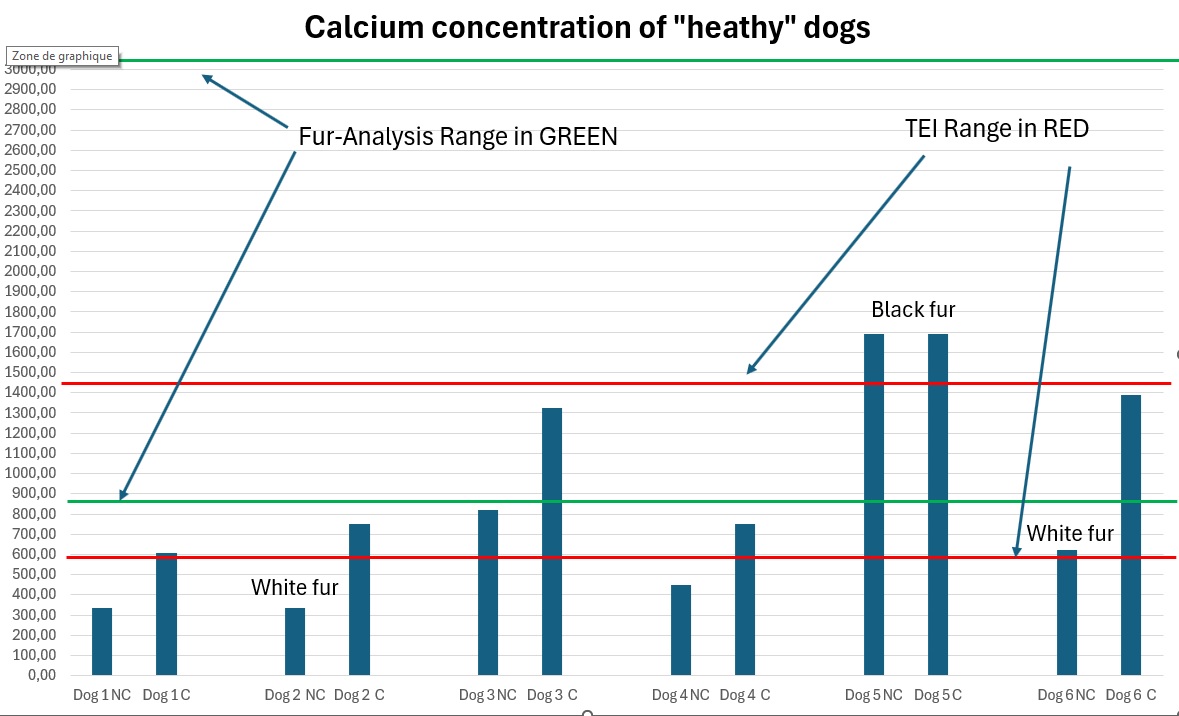
An uncorrected white sample may fall below a reference interval while pigmented fur from the same animal falls inside or above it.
A key source of analytical bias
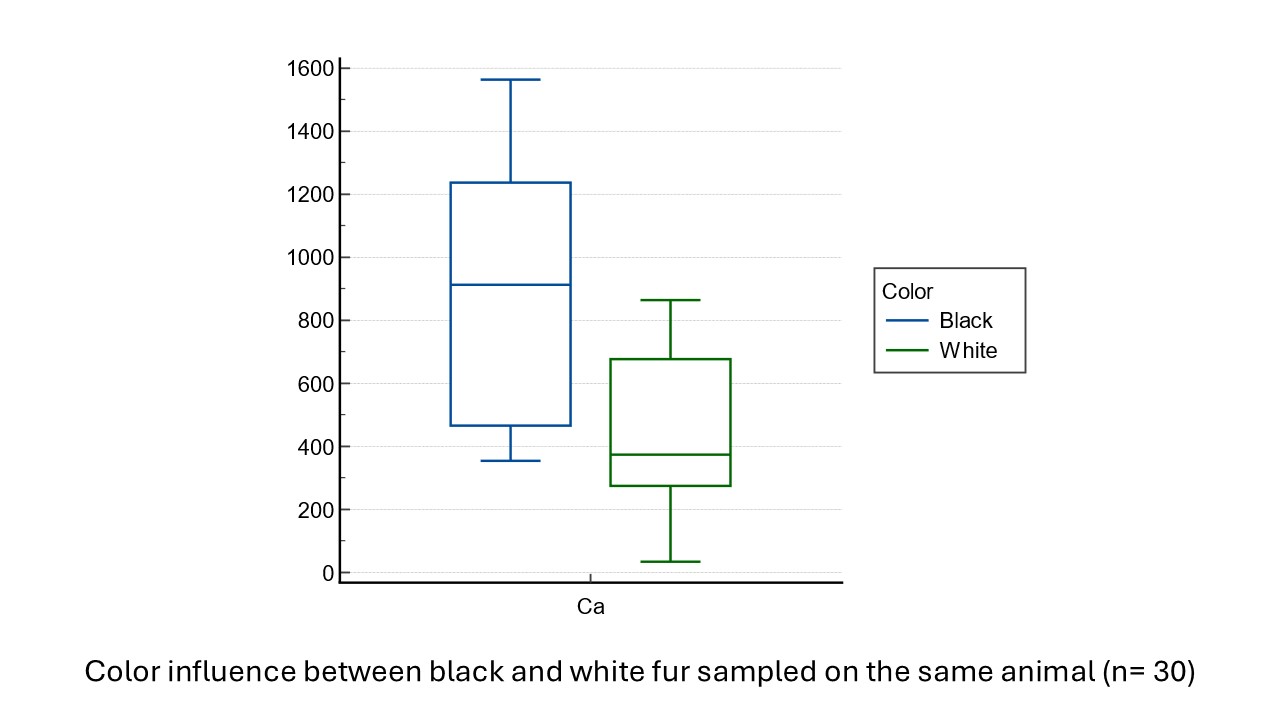
Dark and light fur from the same animal can produce substantially different mineral concentrations. For colour-sensitive elements, ignoring pigmentation can create avoidable analytical bias and misleading longitudinal comparisons.
The analytical problem
Hair pigmentation changes the physical and chemical matrix being analysed. Melanin and associated structural differences can alter the retention of selected elements. The direction and magnitude of the effect are not identical for every element, species or study.
An uncorrected white sample may fall below a reference interval while pigmented fur from the same animal falls inside or above it.
A change of sampled coat colour between two visits may look like a biological change even when exposure and physiology are stable.
Breed or disease groups with different coat-colour distributions can generate confounding in epidemiological and biomarker studies.
Internal paired-sample evidence
Delta-Fur evaluated pigmentation using paired samples from 50 multicoloured animals. Each animal acted as its own control, substantially limiting confounding by breed, diet, age, sex, environment and clinical status. For the elements affected by pigmentation, darker fur consistently produced higher uncorrected concentrations than lighter fur from the same animal.
Published evidence
Coat colour is a recognised non-nutritional source of variation in hair mineral analysis. Recent canine and calf studies confirm that the effect remains relevant with modern ICP-MS methods.
FurAnalysis methodology
Our workflow treats coat colour as a measured analytical variable rather than a descriptive note.
The sampled colour and any mixed-colour collection are recorded at reception.
Each sample receives a continuous Degree of Whiteness score from 0 (dark) to 100 (white).
For validated colour-sensitive elements, an element-specific model adjusts the result toward a common reference colour.
The original ICP-MS measurement remains traceable while the corrected value improves interpretation and follow-up.
Why continuous measurement matters
Grey, cream, brown, red, diluted, mixed and partially white coats cannot be handled reliably with two categorical labels. A quantitative scale captures intermediate pigmentation and avoids abrupt correction boundaries.
Why colours should not be mixed
A sample containing mostly dark fur will not produce the same result as a sample containing mostly white fur. Mixing colours hides the pigmentation effect and makes the result depend on the unknown proportion of each colour.
Whenever possible, different coat colours should be kept separate. Delta-Fur records the sampled colour, measures its degree of whiteness and applies correction only to validated colour-sensitive elements.
Sampling location
In a pilot intra-individual experiment, white fur was collected from six anatomical locations on the same dog. For the elements used in our interpretation, the results were sufficiently stable across locations.
This one-animal pilot does not prove that location never matters. It supports our practical conclusion that, under the FurAnalysis protocol, coat pigmentation is the more important systematic factor to control.
Why this is differentiating
Simply asking whether an animal is black or white does not remove pigmentation bias. FurAnalysis combines paired within-animal validation, objective colour measurement and element-specific correction within the routine analytical workflow.
Reference intervals and longitudinal changes are less dependent on the sampled coat colour.
Colour correction reduces confounding in case–control studies, multivariate models and future integrated FurExposome indices.
We correct validated effects without claiming that every element or every biological interpretation is colour-independent.
Integrated biomarkers and artificial intelligence
If pigmentation is ignored, a machine-learning model may associate dark fur with higher sodium, magnesium, phosphorus, potassium, calcium or manganese. If coat-colour distributions differ between clinical groups, the algorithm can mistake pigmentation for a disease or exposure signature.
Colour correction is therefore an essential preprocessing step before constructing reference populations, case–control models, multielement indices or integrated ICP-MS–Orbitrap FurExposome workflows.
Selected scientific references
Conclusion
A laboratory can use a highly sensitive ICP-MS and still produce biased comparisons if coat pigmentation is ignored. Objective, element-specific colour correction is therefore not cosmetic: it is a quality-control step that strengthens routine reports, repeat monitoring and biomarker research.
Frequently asked questions
No. The effect is element-specific. FurAnalysis applies correction only where a reproducible pigmentation effect has been demonstrated.
No. Pigmentation is continuous. A quantitative whiteness score is more defensible for grey, brown, cream, red and mixed coats.
Sodium, magnesium, phosphorus, potassium, calcium and manganese are currently corrected within the validated workflow.
Sampling should be standardised. In our one-dog pilot, white fur from six anatomical locations was sufficiently stable for the intended interpretation, but broader studies remain useful.
Yes. The original ICP-MS value remains traceable; the validated corrected value is used to improve comparability.
Delta-Fur combines ICP-MS, controlled preparation, coat-colour measurement and scientifically cautious interpretation.